Immigration Consulting Services: Sponsor Licence Specialists
With 30 years of combined experience in immigration matters, our team specialises in sponsor licence applications, human rights cases, and detention-related issues. We have successfully secured sponsor licences for diverse businesses including food and beverage establishments, care homes, courier services, technology companies, and startups.
Our expertise enables us to maximise your chances of success. We provide comprehensive guidance throughout the entire process, ensuring you receive professional support from application submission to approval.
Directory
- Introduction – Common Misconceptions About Sponsor Licences
- Do I need to start trading my business with minimum 3 years, to be eligible to apply sponsor licence?
- Can I sponsor myself in the company I establish?
- If my parents own the company, can they sponsor me?
- I have a portfolio of businesses, including nail shops, salons, and takeaway businesses. People saying these businesses are impossible to get sponsor licence. Is this the case?
- Do I have to hire British people or permanent residents to be the director in order to apply sponsor licence?
- Once I have a sponsor licence, how many people can I normally hire in one year under skilled worker visa route?
- I am aware home office might want to come for audit in person or online. What are the areas they are looking for? Can I have my legal rep to be there and facilitate the audit?
- I have been issued wages to my staff in cash, if this is a huge problem when I submit the application for sponsor licence?
- In the sponsor licence, there’s Level 1 user, key authorizing officer and key contact. Can I use one person to be responsible for all three areas? Is there any legal status required for these positions? And can these people be working part-time? Or does it have to be full time employee?
- If I have 5 shops in the UK, do I have to have 5 sponsor licences for each shop? Or I can just have one, and place them in a different shop?
- Can I have virtual or home address to be the office address, when submitting sponsor licence application?
1. Common Misconceptions About Sponsor Licences
Many business owners believe they need to meet specific revenue thresholds, operate at a certain scale, or demonstrate profitability to qualify for a sponsor licence. The Home Office does not explicitly stipulate such requirements.
However, your application must clearly demonstrate a legitimate need for hiring international talent that aligns with your business objectives. Our consultants can help you articulate this need effectively and develop a compelling case.
We invite you to schedule a consultation with our team. We’ll assess your specific circumstances and guide you through every step of the sponsor licence application process.
Success Cases

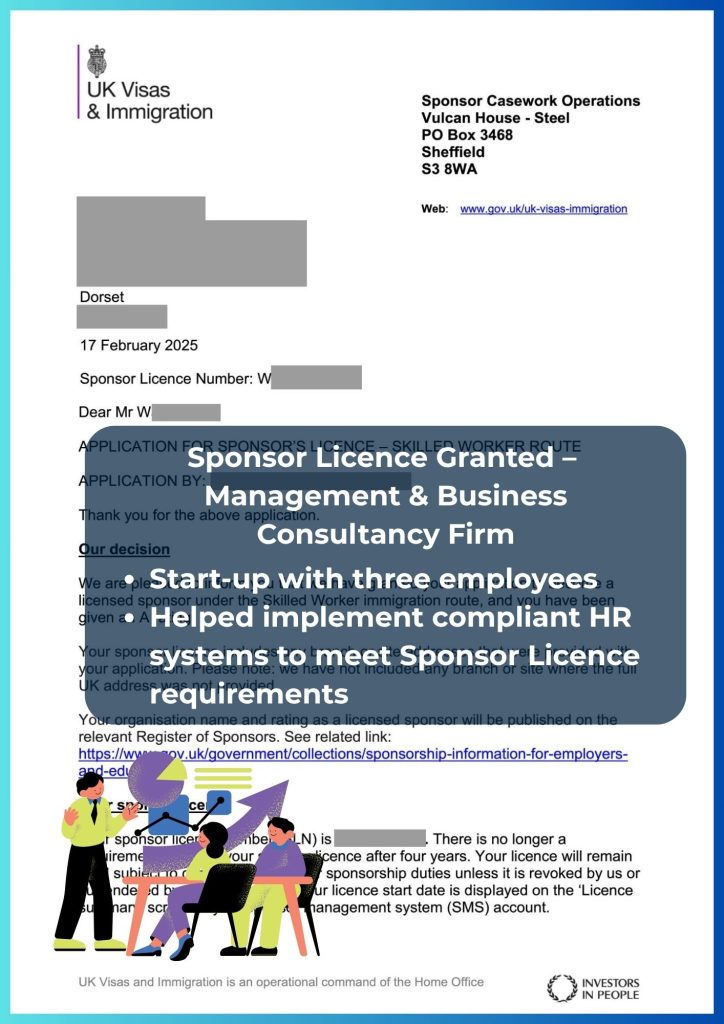
Professional, fast and experienced!
2. Do I need to start trading my business with minimum 3 years, to be eligible to apply sponsor licence?
There is no requirement for a minimum trading period before the application for a sponsor licence. The Home Office will consider whether the business has demonstrated a genuine need for the sponsor licence to hire skilled workers, meaning even for Start Up companies, they are eligible to apply for a sponsor licence too as long as they can demonstrate the same. The consideration is different for Start Up companies, and the required documents needed in support of your sponsor licence application would slightly differ.
The Home Office would further look at whether the company is able to maintain the skilled workers and have the relevant systems in place to be able to monitor them. The sponsor licence holder would have to demonstrate that they understand the compliance duties attached with being a sponsor licence holder.
3. Can I sponsor myself in the company I establish?
There are no rules to say that one cannot sponsor themselves in the company established by themselves, however, the Home Office may question whether the position being offered is a genuine one. As part of the requirements for a skilled worker visa, the decision make must be satisfied that the job the applicant being sponsored to do does not exist, is a sham, or has been created mainly so the applicant can apply for entry clearance or permission to stay. Where the applicant has established the company, the Home Office may question whether the company was established for the applicant to subsequently obtain the skilled worker visa, thereby falling short of the requirements for a skilled worker visa.
To avoid this, during the application for skilled worker, the applicant would have to demonstrate that the company has a genuine vacancy and position for the skilled worker. They would also have to demonstrate there is a genuine need.
4. If my parents own the company, can they sponsor me?
There are no rules to state that if the company is owned by the parents, the company is not able to sponsor the applicant. In accordance with the rules, someone who is a Level 1 user of the sponsor licence cannot assign a COS to a family member, but there are no rules surrounding who must be the Level 1 user (for example, directors or shareholders).
Though it is important to note that during the skilled worker application process, on the application form, you will be asked about the details of your parents. This information may be used to conduct further checks for your skilled worker application, such as checks on Companies House regarding the business that will sponsor you.
If your parents own the company and are listed as the director and/or shareholders of the company, then the Home Office may have doubts regarding whether the position is genuine, thus affecting your skilled worker visa application.
5. I have a portfolio of businesses, including nail shops, salons, and takeaway businesses. People saying these businesses are impossible to get sponsor licence. Is this the case?
There are no rules surrounding what businesses CANNOT apply for a sponsor licence. All businesses are permitted to apply for a sponsor licence, but you would have to demonstrate a genuine need for the sponsor licence and hiring skilled workers. You would also have to demonstrate that you can fulfil the compliance duties attached with being a sponsor licence holder.
There are rumours regarding nail shops, salons and takeaway businesses being impossible to get a sponsor licence as it is usually more difficult to get sponsor licences for these business types due to the nature of the business and often size of the business. However, the skilled occupations include occupations such as chef or salon managers, permitting those with these occupations to get a skilled worker visa, therefore, businesses which have a genuine need for these skilled workers can also apply for a sponsor licence.
Clear real price, no hidden charges!
6. Do I have to hire British people or permanent residents to be the director in order to apply sponsor licence?
No, you do not necessarily to hire a British citizen or permanent resident to be the director of the company for the purpose of applying for sponsor licence. However please note that there are requirements for appointment of Authorising Officer and Level 1 User for the Sponsor Licence.
- Authorising Officer must be the most senior person in your organisation responsible for the recruitment of all sponsored workers and ensuring you meet all of your sponsor duties
- Level 1 user must be an employee of your organisation (could be a director or a partner), and must be a ‘settled person’ (British or Indefinite Leave to Remain)
In Summary, in order to apply for a sponsor licence, you must have an employee who is a British or permanent resident to be the Level 1 User of the licence.
7. Once I have a sponsor licence, how many people can I normally hire in one year under skilled worker visa route?
There is no fixed number of people that you can recruit in a yearly period. You may justify your needs to the Home Office of recruitment plan, by taking into account the needs of your business, the necessity of recruitment, the interest of the business and more.
8. I am aware home office might want to come for audit in person or online. What are the areas they are looking for? Can I have my legal rep to be there and facilitate the audit?
The purpose of the audit is for the Home Office to be satisfied that you and your business have the necessary mechanism in place to comply with the sponsor duties, as a licensed sponsor. The Home Office in their audits will take into consideration of whether or not your business is familiar with the recruitment process, how do you manage your employees, do you have the capacity to maintain the system etc.
Legal representative is normally not allowed to represent you in the audit but you may instruct a legal representative to prepare the documents that the Home Office request for in advance before the audit.
9. I have been issued wages to my staff in cash, if this is a huge problem when I submit the application for sponsor licence?
Yes, it could be a problem to a certain extent, because the Home Office prohibits licensed sponsors to pay wages to sponsored workers by cash, it must be made through bank transfer. The Home Office may revoke your licence if you pay the sponsored workers in cash. As such, if you are paying your workers in cash, the Home Office may doubt that you would not comply with sponsor duties, and this could potentially be a problem in the submission of your sponsor licence application.
High success rate, more than 3,000 satisfied customers
10. In the sponsor licence, there’s Level 1 user, key authorising officer and key contact. Can I use one person to be responsible for all three areas? Is there any legal status required for these positions? And can these people be working part-time? Or does it have to be full time employee?
The above three people have different roles which are classified as below: authorising office holds a role of a senior and competent person responsible for the actions of staff and representatives who use the SMS, key contact is the employer’s main point of contact with UK Visas and Immigration (UKVI) and Level 1 user is responsible for all day-to-day management of your licence using the SMS. Although these roles have different roles and responsibilities, these roles can be filled by the same person or different people. We will now refer to the above 3 roles as Key Personnel.
The above roles except authorizing office role can also be filled in by a UK-based legal representative, however, the UK-based legal representative must be qualified to give immigration advice and services. Moving on, the Home Office does not specify whether the Key Personnel need to be in the organization full-time or part-time, as long as they are paid staff or an office holder within your organisation.
The Home Office do impose different requirements on the roles which requires to be checked carefully in order to ensure the appointed person meet all the requirements set forth by the Home Office, especially the authorising office who should be the most senior employee of the company dealing with recruitment of all sponsored workers and ensuring that you meet all of your sponsor duties. It is important to note that the temporary staff member supplied to you by an employment business can be appointed as Level 2 User but not in any of the Key Personnel roles.
11. If I have 5 shops in the UK, do I have to have 5 sponsor licences for each shop? Or I can just have one, and place them in a different shop?
It depends on the formation of the companies, should the entities form part of the branches of the same company then one single licence would be sufficient, but the branches must be registered with the Home Office. You are required to provide evidence to prove the relation between the two entities. For example, the lease owned by the same owner, or the parent company, etc.
12. Can I have virtual or home address to be the office address, when submitting sponsor licence application?
Yes, you can. In accordance with L.8.17 of UKVI’s guidance, “If you operate a virtual business model (with little or no physical office space), it is highly likely that we will conduct a compliance check with your Authorising Officer, which may include a compliance visit to their physical address, before making a decision on your application for a licence.” and under Section L8.17 confirms that an Authorising Officer of a business with no physical office premises (i.e. a virtual business model) may receive a compliance visit at home. Based on the above two provisions quoted, the Home Office recognised that the business maybe operated virtually and no physical office present thus home address is acceptable.
Five branches in the United Kingdom, more than 80 staff at your service!
Success Cases


Client Reviews